What to Look for in a Dog Daycare (A Complete Guide)
Choosing a dog daycare? Learn the key criteria to evaluate -- staff ratios, safety protocols, vaccinations, and more -- before you commit.
So you've decided your pup deserves a social life. Good for you! Choosing the right dog daycare is one of the best decisions you can make for your furry friend, but it can also feel a little overwhelming if you've never done it before.
With so many options out there, how do you know which facility is actually safe, fun, and worth your hard-earned money? The truth is, not all dog daycares are created equal. Some are absolute tail-wagging paradises, while others might leave you with more questions than peace of mind.
That's exactly why we put this guide together. Whether you're a first-time dog owner or just exploring daycare for the very first time, we're breaking down everything you need to look for before handing over your precious pup. From staff qualifications and safety protocols to play spaces and daily routines, this list covers all the key factors that separate a great dog daycare from a not-so-great one. By the end, you'll feel confident, informed, and ready to find the perfect fit for your four-legged family member.
Why Dog Daycare Is Worth Taking Seriously
If you've ever wondered whether dog daycare is just a trendy splurge, the numbers tell a very different story. The global dog daycare market was valued at $5.8 billion in 2025 and is projected to nearly double to $11.4 billion by 2034, according to recent dog daycare market research. That kind of growth doesn't happen around a passing fad. It reflects millions of pet owners making a deliberate, recurring decision to invest in structured care for their dogs.
Here in the Cincinnati and Glendale area, you're sitting right at the heart of this boom. North America accounts for 42.3% of global dog daycare revenue in 2025, making it the most competitive and quality-driven market on the planet. That means local dog owners have access to more options, higher standards, and better services than almost anywhere else in the world.
A big reason for this growth is something researchers call pet humanization, which is simply the trend of treating your dog as a full family member rather than just a pet. When your dog is family, the bar for their care gets much higher. You're not just looking for somewhere to drop them off; you're looking for a place that matches your own standards for safety, socialization, and well-being.
It's also worth noting that full-day care now makes up 38.5% of all daycare service revenue, confirming that regular, recurring daycare has become a weekly routine for many dual-income households. With more options entering the growing pet daycare market every year, knowing how to evaluate your choices has never been more important.
Staff-to-Dog Ratios: The Number That Actually Matters

When it comes to evaluating a dog daycare, the staff-to-dog ratio is one of the most important numbers you can ask about. Industry guidance from the International Boarding and Pet Services Association recommends a maximum of 1 staff member per 10 to 15 dogs during active supervised group play. The lower end of that range (1:10) applies to higher-risk situations like mixed-size groups, new dogs, or high-energy play sessions. If your dog is small, is a puppy, or has any behavioral notes on file, expect a responsible facility to keep ratios even tighter than that.
This is also one of the most common corners cut at budget facilities. More dogs per staff member means less eyes on the group, slower intervention when tension builds, and a higher chance that a minor scuffle turns into a real injury. According to best practices for safety in dog care facilities, understaffed groups shift handlers from preventing problems to simply reacting to them, and that difference matters enormously for your dog's safety.
Here is a key question most owners forget to ask: how are ratios managed during peak drop-off hours? Many facilities look fine on paper but quietly overload staff during the 7 to 9 a.m. rush. Ask specifically about their busiest window, not just a daily average.
Watch out for vague answers like "we always have plenty of staff on the floor." That response, without specific numbers attached, typically means the facility has never formalized the standard. Dog daycare safety experts consistently flag non-numerical answers as a red flag worth taking seriously.
At Cincinnati Dog Depot in Glendale, Ohio, attentive supervision ratios are a core part of how daily play groups are managed. When you schedule a tour, ask directly about their numbers.
Vaccination and Health Requirements: Non-Negotiable Standards
Before your dog sets one paw through the door, a reputable facility should already have copies of their vaccination records on file. At minimum, look for requirements covering rabies, distemper (DHPP), and Bordetella (kennel cough). Rabies is actually a legal requirement in most U.S. states, as outlined in dog vaccination laws across the country, so any facility not asking for it is already a red flag. Bordetella spreads easily in group settings, making it especially critical in a daycare environment where dogs are nose-to-nose all day long.
If you're in or near a metro area like Cincinnati, where dogs from dozens of different households mix daily, some facilities also require the canine influenza (H3N2/H3N8) vaccine. This is not overkill; it reflects smart risk management in a high-density environment.
Here is a quality signal worth noting: ask whether the facility verifies vaccination records directly with your veterinarian or simply takes your word for it. Facilities that confirm records with your vet directly are holding themselves to a higher standard, and that matters.
Parasite screening at drop-off is another layer of protection that often goes unasked. A facility that checks for fleas, ticks, and other external parasites during intake is actively protecting every dog in the building, not just yours.
Finally, a quick visual health check at drop-off, covering eyes, coat condition, and general behavior, signals that staff are trained to catch early illness before it spreads through the group. It takes about 60 seconds and makes a significant difference.
How Play Groups Are Structured and Supervised
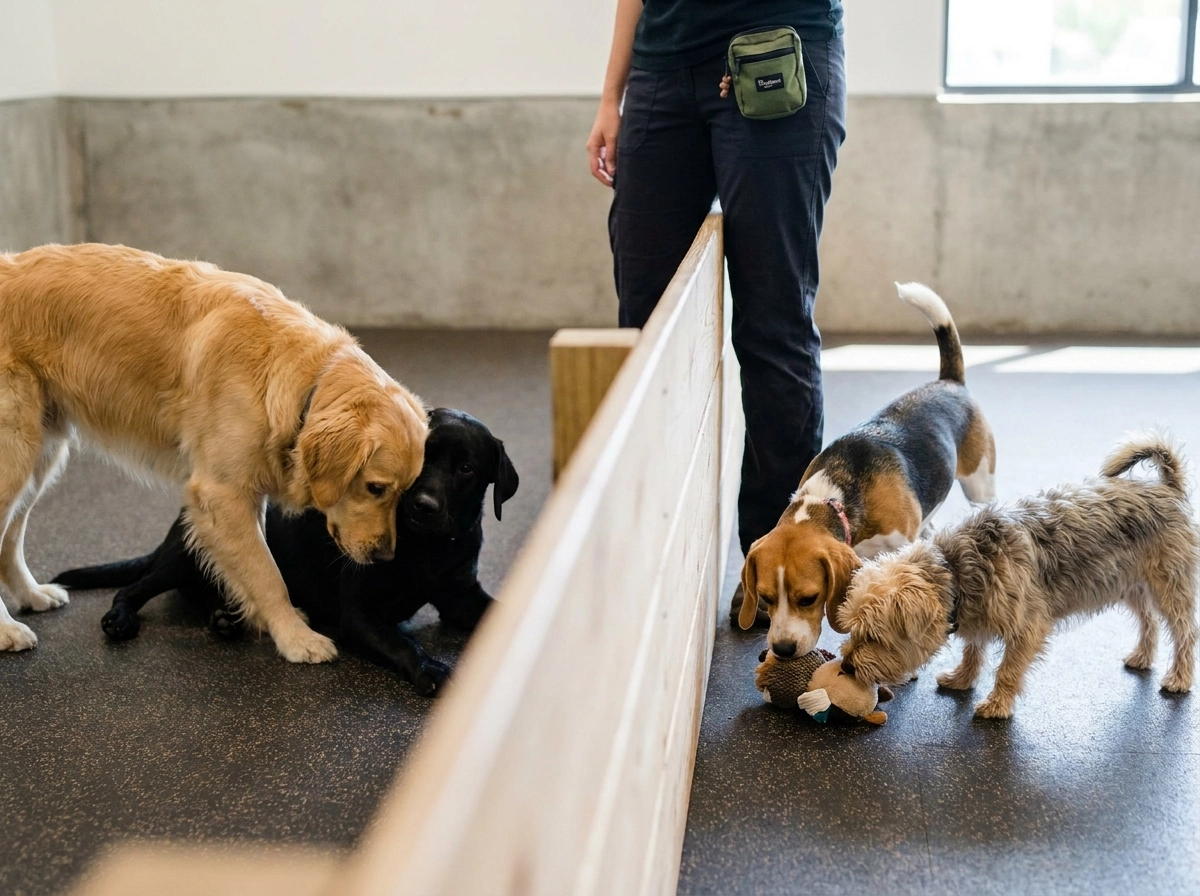
Not all play groups are created equal, and the way a facility organizes its dogs tells you a lot about how seriously they take safety. Quality daycares separate dogs by size, temperament, and energy level rather than throwing everyone into one big room. Mixing a 90-pound Labrador with a 10-pound Chihuahua is not a personality clash waiting to happen; it's a preventable safety risk. A bouncy, rough-playing dog can accidentally injure a smaller dog without any aggressive intent at all. Ask the facility directly how they group their dogs, and expect a specific answer, not a vague "we watch them closely."
Before your dog ever joins a regular group, a thoughtful facility will want to get to know them first. Temperament assessments or supervised trial days are a strong indicator that a facility cares about the existing group dynamic, not just filling spots. This evaluation protects your dog just as much as it protects the other dogs already enrolled.
It's also worth asking what happens when a dog is having a rough day. A strong facility will have quiet rest spaces where an overstimulated dog can decompress, not just pull them from the group and send them home without explanation. Physical environment matters here too; look for indoor and outdoor play areas with shade, fresh water, and separation options readily available.
Finally, ask about staff training in canine body language. Stiff postures, whale eye, and resource guarding are early warning signals that require a calm, informed response before the situation escalates. Trained eyes on the floor make all the difference.
Cleanliness and Physical Safety of the Facility
Even after checking off staffing ratios, vaccination requirements, and play group structure, there is one more step that no amount of online research can replace: walking through the facility yourself. A brief tour gives you immediate, unfiltered information that a brochure or website simply cannot. When you walk in, pay attention to your nose first. A strong ammonia smell is a red flag that waste cleanup is not happening promptly. A genuinely clean facility will smell fresh, or at most mildly like dogs, never sharp or sour. Look for staff actively cleaning, visible disinfectant supplies, and surfaces that appear dry and well-maintained. According to safety standards outlined by veterinary professionals, playrooms, kennels, and common areas should be disinfected daily using pet-safe products, with accidents addressed immediately to prevent the spread of kennel cough, parasites, and skin conditions. Ask whether sanitation schedules are posted or available on request; a confident, transparent facility will have no problem showing you.
While you are looking around, check the floors. Non-slip surfaces are a practical safety detail that is easy to overlook but genuinely important when dogs are running, turning, and playing at full speed. Slick concrete or hard tile increases the risk of falls and joint injuries, particularly for larger, heavier breeds. Quality facilities increasingly use rubber or coated flooring systems that provide traction and are easier to sanitize, per current facility design standards.
Also look at the entry and exit points. Double-gated, airlock-style doors are a standard safety feature at reputable facilities, preventing dogs from bolting during the busy moments of drop-off and pick-up. Finally, if outdoor play areas are part of the program, confirm that fencing is fully intact with no gaps, rust, or shared fence lines with neighboring properties. In suburban areas like Glendale and surrounding Cincinnati neighborhoods, an unknown animal on the other side of a shared fence can create real disease and temperament risks worth taking seriously.
Staff Qualifications and Ongoing Training
The qualifications of the people handling your dog matter just as much as the physical space they're in. Ohio does not legally require dog daycare staff to hold any specific certifications, which means the burden falls entirely on you as a pet owner to ask the right questions. Certifications like Pet First Aid and CPR are not mandatory, but a facility that has pursued them voluntarily is signaling something important: they care about animal safety beyond the bare legal minimum. When you call to inquire about a facility, simply ask whether staff are certified and by whom.
Staff turnover is an underrated quality signal that most people overlook. Dogs are creatures of habit, and they genuinely relax more around handlers they recognize. A facility with consistent, familiar staff creates a calmer, safer environment for your dog. High turnover, on the other hand, often points to deeper issues with management, compensation, or workplace culture. It is absolutely worth asking how long the average staff member has been with the facility.
Training in canine body language should also be ongoing rather than a one-time orientation checklist. Recognizing stress signals like lip licking, stiff posture, or avoidance behaviors requires practice and continued learning. Platforms like Dog Handler Academy exist specifically to train daycare staff in real-world canine behavior scenarios, which shows how seriously the industry takes this.
Ask about emergency protocols too. A quality facility should be able to tell you exactly which emergency veterinary clinic they work with, how staff are authorized to approve treatment, and at what point you will be contacted.
Facilities that also offer grooming, like our team here at Cincinnati Dog Depot in Glendale, Ohio, often bring a broader depth of animal handling experience to their daycare floor as well.
Transparency and Daily Communication with Owners
Once you've toured the facility, checked the staff ratios, and verified the vaccination requirements, there's one more layer of quality to evaluate: how well a facility keeps you in the loop once you hand over the leash and walk away.
In 2026, tech-enabled communication is not a perk. Webcam access, photo updates, and app-based messaging are now baseline expectations that quality providers offer as a matter of course. Think of them as trust signals rather than upgrades. When you're evaluating a new facility, the absence of these features is worth noting. A daycare that cannot tell you how your dog's morning went is asking for a level of blind faith that no pet parent should feel pressured to give.
Beyond real-time access, look for facilities that send a daily report or end-of-day summary covering how your dog ate, played, and behaved. This small practice separates genuinely engaged facilities from ones that are simply moving dogs through the door. It also gives you useful information over time, especially if your dog has health sensitivities or behavioral quirks worth tracking.
It's also smart to ask directly: what happens if something goes wrong? A professional facility should have a written incident report process and a same-day owner notification policy. If the staff member you're talking to can't explain that process clearly, that's a red flag worth taking seriously.
Responsive online booking and attentive customer service also matter more than they might seem. How a facility handles a scheduling question is a preview of how they'll handle an emergency. Facilities that actively share photos and social updates are sending an equally clear signal: they're confident in what's happening inside their walls, and they want you to see it. That kind of openness, paired with the latest thinking in the pet boarding and daycare industry, reflects the kind of owner-focused operation worth trusting with your dog.
Bundled Services: Getting More From a Single Visit
More and more pet owners are looking for a single facility that can handle daycare, grooming, and boarding all in one place. The logic is simple: fewer drop-offs means fewer transitions, and fewer transitions means less stress for your dog. Every time a dog enters an unfamiliar environment, it takes time and energy to adjust. When you can consolidate those visits into one trusted location, your dog spends less time anxious and more time comfortable.
This matters especially if you travel for work or take regular trips. A dog that attends daycare at a facility already knows the staff, recognizes the smells, and understands the routine. When that same dog needs to board overnight, the experience feels far less like a disruption. That familiarity is genuinely calming for dogs, and it makes a provider that offers both daycare and boarding a meaningful upgrade for travel-heavy households.
For busy commuters in communities like Montgomery, Blue Ash, and Glendale, scheduling a bath or nail trim on an existing daycare day is one of those small time-savers that adds up quickly. Instead of making a separate trip to a groomer on a Saturday, you drop your dog off in the morning and pick them up clean and trimmed in the evening. With pet care service costs rising steadily and household schedules getting tighter, that kind of efficiency has real value.
Cincinnati Dog Depot provides daycare, boarding, and grooming services for both dogs and cats, making it one of the few independent providers in the area equipped to handle multi-pet households in a single visit. When you're evaluating any facility, ask directly whether grooming add-ons like baths or nail trims can be scheduled on the same day as a regular daycare drop-off, and whether services are bundled or billed separately. Knowing that upfront helps you plan and budget without surprises.
Understanding Pricing and What You Are Actually Paying For
Pricing in the dog daycare world is less straightforward than most people expect, and understanding what you're actually paying for can save you from some unpleasant surprises. In the Cincinnati area, day rates can vary quite a bit from one facility to the next. A lower price tag often reflects real tradeoffs, including higher dog-to-staff ratios, minimal enrichment programming, or more relaxed health screening at intake. When you're paying less per day, something is usually absorbing that cost difference, and it's rarely something you'd want to sacrifice.
If your dog is going to daycare multiple days a week, it's worth asking about weekly or monthly package pricing. Many facilities offer meaningful per-day discounts when you commit to a recurring schedule. For dual-income households that rely on daycare five days a week, even a small per-day reduction adds up quickly over a month.
Hidden fees are also worth asking about before you commit. Common extras include charges for administering medication, late pickup fees, holiday surcharges, and one-time temperament assessment or trial day fees. These are industry-wide practices, not red flags on their own, but you deserve to know the full cost upfront.
Independent providers can often offer more flexibility on pricing and scheduling than large franchise chains, along with a more personalized experience that gets harder to deliver at scale. At the end of the day, the goal isn't finding the cheapest option; it's finding the best balance of quality and cost for your specific dog.
How to Use This Checklist When You Visit a Facility
Before you tour your first facility, save this quick checklist to your phone or print it out and bring it along. You want to check off all eight criteria we covered: staff-to-dog ratios (aim for 1:10 or better), verified vaccination requirements, structured play group separation, a clean and well-designed physical space, qualified and trained staff, transparent daily communication, fair and clearly explained pricing, and bundled services that simplify your routine.
No website, photo gallery, or glowing review can tell you what five minutes inside a facility will. The smell, the noise level, how staff talk to the dogs already in their care, whether the space feels calm or chaotic, all of that becomes obvious the moment you walk through the door. Any confident facility will welcome you without hesitation.
We invite you to bring that checklist to Cincinnati Dog Depot in Glendale, Ohio and see how we measure up. We offer daycare, grooming, and boarding for both dogs and cats, so whether you have one pet or a houseful, we can help.
The right choice now pays off every single day. A dog that feels safe and happy at daycare comes home calmer, better socialized, and easier to live with. If you have questions before you ever schedule a visit, just reach out. We are happy to talk through what your dog needs before you commit to anything.
Conclusion
Finding the right dog daycare does not have to feel overwhelming. Keep these key takeaways in mind: prioritize facilities with qualified, caring staff; look for clean and secure play spaces; confirm that proper safety protocols are in place; and trust your gut when you visit in person.
Your dog deserves a place where they feel safe, happy, and genuinely cared for. The good news is that the perfect facility is out there waiting for you and your pup.
Now it is time to put this guide to work. Start by making a list of local daycares, schedule a few tours, and ask every question on your mind. No question is too small when it comes to your dog's well-being. Your pup gave you their whole heart. Help them find a second home that deserves it.